The Manhattan Project
The United States concealed its project to develop an atomic bomb under the name "Manhattan Engineer District." Popularly known as the Manhattan Project, it carried out the first successful atomic explosion on July 16, 1945, in a deserted area called Jornada del Muerto ("Journey of the dead") near Alamagordo, New Mexico.
Dropping the First Atomic Bomb
At 2:45 A.M. local time, the Enola Gay, a B-29 bomber loaded with an atomic bomb, took off from the US air base on Tinian Island in the western Pacific. Six and a half hours later, at 8:15 A.M. Japan time, the bomb was dropped and it exploded a minute later at an estimated altitude of 580 +- 20 meters over central Hiroshima.
The Hiroshima Bomb
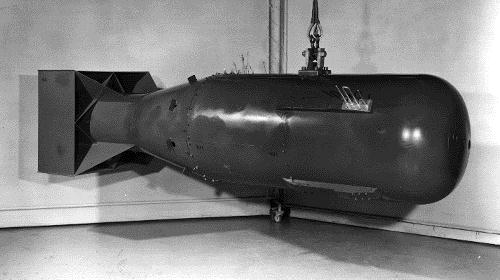
Size: length - 3 meters, diameter - 0.7 meters.
Weight: 4 tons.
Nuclear material: Uranium 235.
Energy released: equivalent to 12.5 kilotons of TNT.
Code name: "Little Boy".
Initial Explosive Conditions
Maximum temperature at burst point: several million degrees centigrade. A fireball of 15-meters radius formed in 0.1 millisecond, with a temperature of 300,000 degrees centigrade, and expanded to its huge maximum size in one second. The top of the atomic cloud reached an altitude of 17,000 meters.
Black Rain
Radioactive debris was deposited by "black rain" that fell heavily for over an hour over a wide area.
Demaging Effects of the Atomic Bomb
Thermal Hear. Intense thermal heat emitted by the fireball caused severe burns and loss of eyesight. Thermal burns of bare skin occurred as far as 3.5 kilometers from ground zero (directly below the burst point). Most people exposed to thermal rays within 1-kilometer radius of ground zero died. Tile and glass melted; all combustible materials were consumed.
Blast. An atomic explosion causes an enormous shock wave followed instanteneously by a rapid expansion of air called the blast; these represent roughtly half the explosion's released energy. Maximum wind pressure of the blast: 35 tons per square meter. Maximum wind velocity: 440 meters per second. Wooden houses within 2.3 kilometers of ground zero collapsed. Concrete buildings near ground zero (thus hit by the blast from above) had ceilings crushed and windows and doors blown off. Many people were trapped under fallen strunctures and burned to death.
Radiation. People exposure within 500 meters of ground zero was fatal. People exposed at distances of 3 to 5 kilometers later showed symptoms of aftereffects, including radiation-induced cancers.
Bodily Injuries
Acute symptoms. Symptoms appearing in the first four months were called acute. Besides burns and wounds, they included: general malaise, fatigue, headaches, loss of appetite, nausea, vomiting, diarrhea, fever, abnormally low white blood cell count, bloody discharge, anemia, loss of hair.
Aftereffects. Prolonged injuries were associated with aftereffects. The most serious in this category were: keloids (massive scar tissue on burned areas), cataracts, leukemia and other cancers.
Atomic Demographics
Population. The estimated pre-bomb population was 300,000 to 400,000. Because official documents were burned, the exact population is uncertain.
Deaths. With an uncertain population figure, the death toll could only be estimated. According to data submitted to the United Nations by Hiroshima City in 1976, the death count reached 140,000 (plus or minus 10,000) by the end of December, 1945.
Health Card Holders. Persons qualifying for treatment under the A-bomb Victims Medical Care law of 1957 received Health Cards; holders as of March 31, 1990, numbered 352,550.
Nagasaki. The atomic bomb dropped on Nagasaki exploded at 11:02 A.M. on August 9. Using plutonium with an explosive power of 20 kilotons of TNT-equivalent, it left an estimated 70,000 dead by the end of 1945, although both population and the deaths are uncertain.
Damages Caused by Atomic Bombs
on Tuesday, March 17, 2009Fat Man is the codename for the atomic bomb that was detonated over Nagasaki, Japan, by the United States on August 9, 1945, at 11:02 a.m. It was the second of the only two nuclear weapons to be used in warfare and was the third man-made nuclear explosion. The name also refers more generically to the early nuclear weapon designs of U.S. weapons based on the "Fat Man" model. It was an implosion-type weapon with a plutonium core.
In essence, the Little Boy design consisted of a gun that fired one mass of uranium 235 at another mass of uranium 235, thus creating a supercritical mass. A crucial requirement was that the pieces be brought together in a time shorter than the time between spontaneous fissions. Once the two pieces of uranium are brought together, the initiator introduces a burst of neutrons and the chain reaction begins, continuing until the energy released becomes so great that the bomb simply blows itself apart.
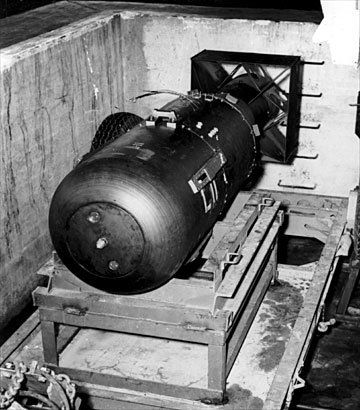
The Little Boy bomb in the bomb pit, ready for loading into the Enola Gay.
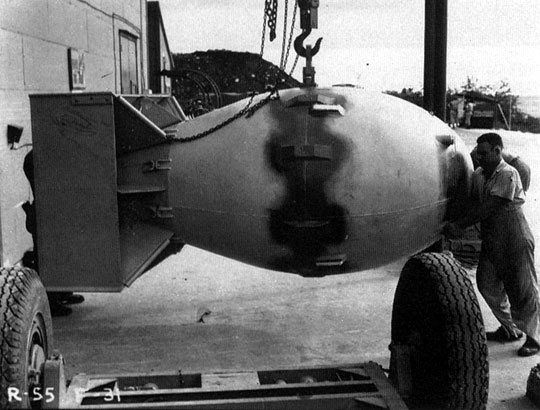
The Fat Man bomb being readied on Tinian.
The rapid spontaneous fission rate of plutonium 239 necessitated that a different type of bomb be designed. A gun-type bomb would not be fast enough to work. Before the bomb could be assembled, a few stray neutrons would have been emitted, and these would start a premature chain reaction leading to a great reduction in the energy released.
NUCLEAR weapon
on Saturday, February 21, 2009Nuclear weapons are the most destructive technology ever developed. From the day fission was discovered in 1938, the problem of controlling this technology has been of central importance to the human race. The world in which this discovery was made - convulsed by war, paranoia, and totalitarian cruelty - made the translation of theoretical possibility into actuality inevitable. The world has been fortunate in the extreme that their only role so far has been to close the worst chapter in the history of war, instead of opening a new one.
In the face of their terrible possibilities, the question "What is to be done?" will never leave us. How can we prevent their use? How can we keep them from evil men? Can we hope to eliminate them entirely? Although these are really questions about human institutions, they cannot be answered without a deep understanding of what nuclear weapons are, and aren't.

The topic is complex and technical: steeped in physics, mathematics, and esoteric engineering. Born in war, the subject has been highly classified from the beginning making it even more inaccessible. Yet this complexity and secrecy has not prevented their acquisition by any nation with an industrial infrastructure advanced enough to build them, and a matching desire. The obstacle to would-be members to the nuclear club has not been discovering how they work, but simply obtaining the tools and materials to make them.
During the Cold War immense empires devoted to the development, manufacture, and potential use of these weapons developed in the United States and Soviet Union. Although motivated by the natural desire for self-protection, much that occurred within these secret enclaves was less than noble. Political posturing, personal ambition, profiteering, and plain carelessness all had their role in deciding the expenditure of staggering amounts of public funds, the exposure of millions of people to risk and injury, and the creation of products and by-products that will burden future generations. Secrecy has been used as a screen from accountability, a tool for personal advancement, and an insider's weapon against challenges as often as a genuine means for protecting national security


